
Apple added a second ad to App Store search results. My downloads stayed flat, my costs doubled
After the recent rollout, overall downloads stayed steady but a large chunk of what used to be organic downloads shifted into paid downloads instead.


I don’t post much about the business side of indie app development, but I noticed something recently that I think is worth talking about.
My Japanese dictionary app, Nihongo, gets almost all of its downloads from App Store search. It’s never been featured by Apple, and it doesn’t appear on any editorial lists, so search visibility is basically everything for the app. Some of those downloads come from Apple Search Ads, and some come organically.
I set up Apple Search Ads years ago, and they’ve generally worked well for me. I use automatic bidding configured around the expected value of a conversion from a tap. So if a yearly subscriber is worth around $50, and a keyword converts at 1%, I can profitably bid around $0.50 per tap. The goal is to roughly break even on the initial conversion, while renewals become profit over time.
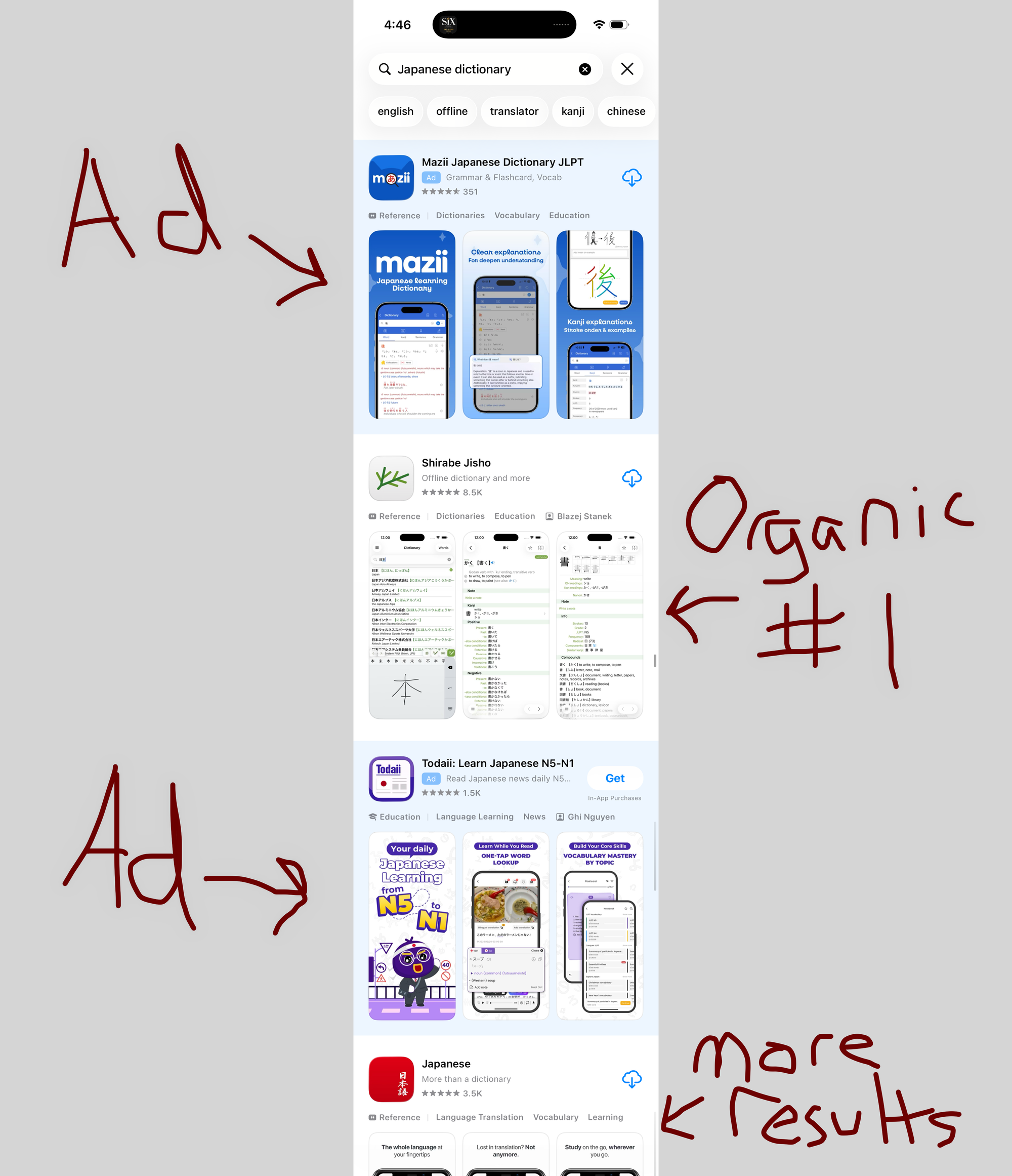
Anyway: a couple months ago, Apple rolled out a second ad placement in App Store search results, effectively adding another ad between the #1 and #2 organic search result slots.
And the results for Nihongo have been pretty depressing.
Before the rollout, my organic and paid downloads had remained pretty steady for most of the last year. After the rollout, my my organic installs dropped, and my paid installs rose. My overall downloads actually stayed roughly flat, but a large chunk of what used to be organic downloads appears to have shifted into paid downloads instead:
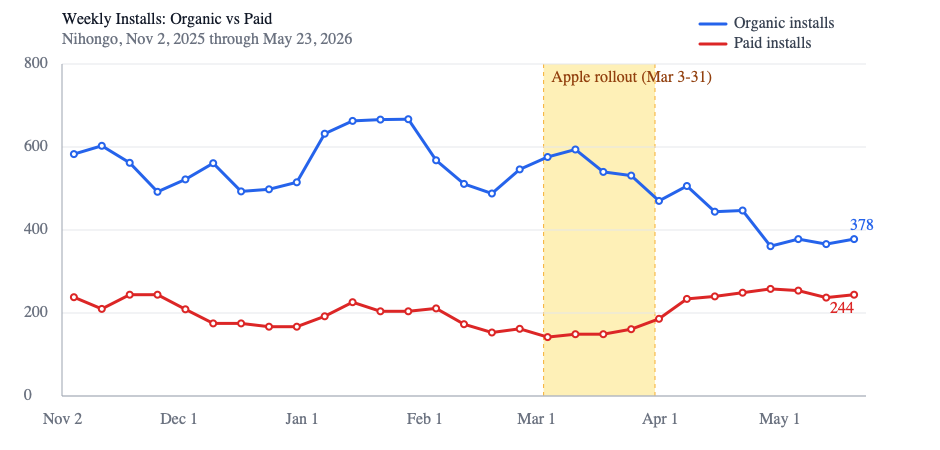
The ads themselves still work well. The problem is that many of these paid downloads seem to be users I previously would have acquired organically.
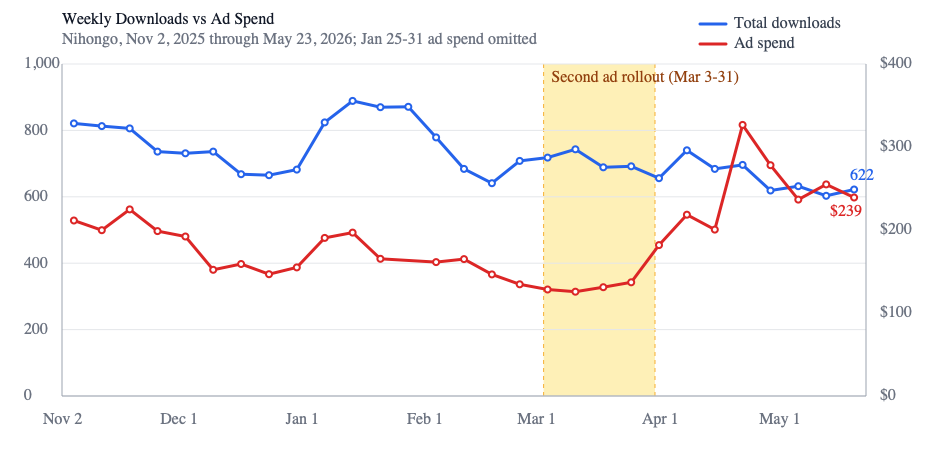
Essentially, my ad spend almost doubled while overall downloads remained steady. Obviously this isn’t a controlled experiment, and correlation isn’t proof. But the timing is hard to ignore:
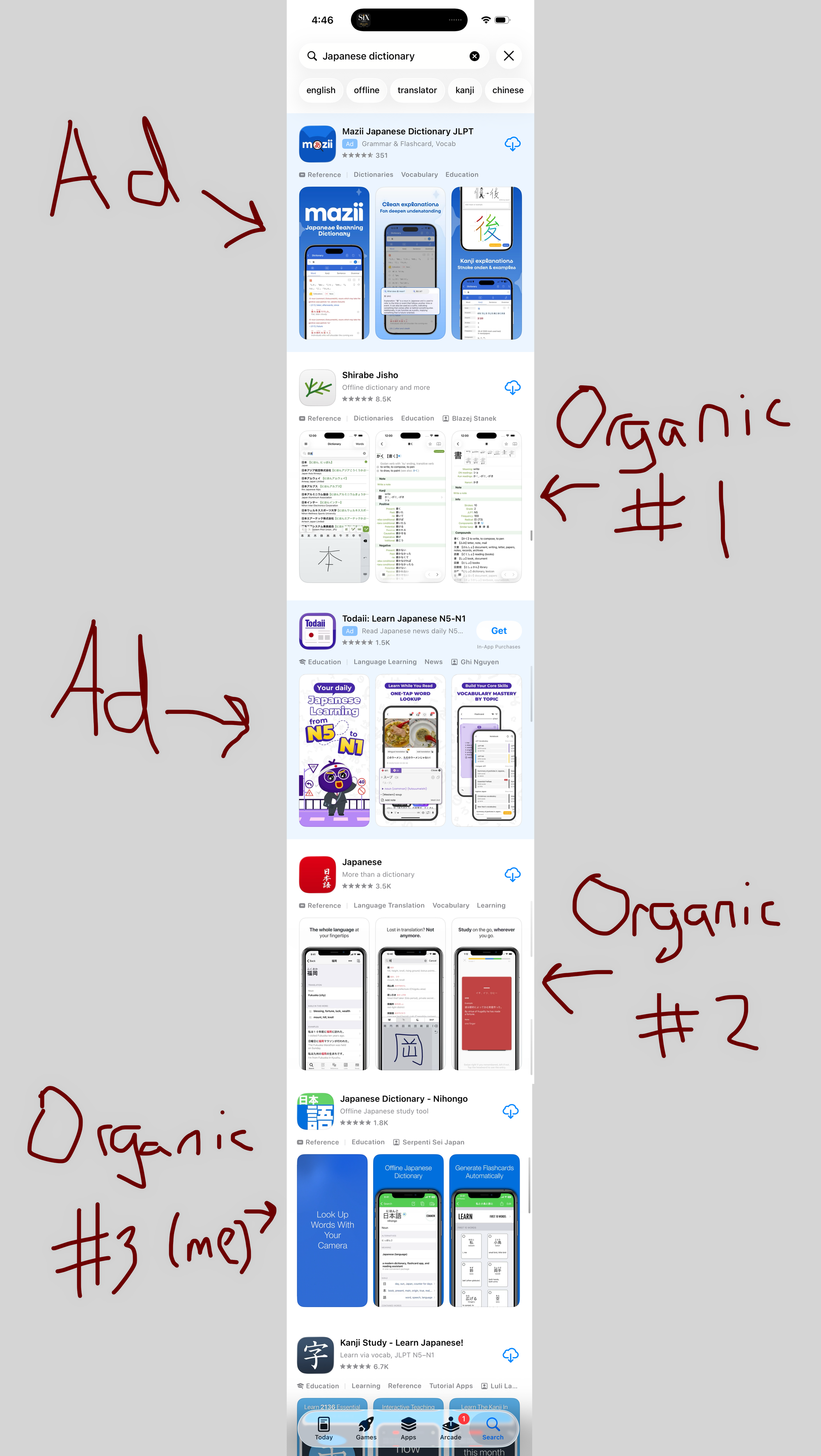
I think part of what’s happening may be specific to categories like mine. There are a couple completely free Japanese dictionary apps that dominate download rankings in the category. Nihongo is a freemium app, and while it performs very well for a lot of searches, it’s often sitting around the #2 or #3 organic position for major keywords like “japanese dictionary.”
Before, those positions still got substantial visibility and downloads. Now, with two ads above the fold, #2 and #3 organic results effectively behave more like #4 and #5. That’s a huge difference in visibility.
So there’s now more ad inventory available, which initially sounded great to me because ads convert well for my app. But the new inventory seems to come largely at the expense of my own organic placement.
Search ads used to feel additive, like a way to accelerate growth. Increasingly, they feel mandatory: a way to pay for visibility you previously earned organically.
I’m Chris Vasselli, an indie developer based in Japan. I make apps including Nihongo, a Japanese dictionary and study app, and Transcrybe, a real-time translation app for Mac.